
CPT (cone penetration testing) pushes an instrumented cone continuously into the ground and returns a near-continuous profile of soil behavior, but recovers no sample. SPT (standard penetration test) drives a split-spoon sampler at intervals and returns both a blow count and a physical sample. CPT gives you more data; SPT gives you soil you can hold.
That’s the short answer. The longer answer is that CPT vs SPT isn’t really a competition — the two tests answer different questions, and the projects that go badly are usually the ones where somebody picked a method to fit a budget instead of to fit the ground.
We build both. TMG manufactures SPT and coring rigs and CPT and DMT test rigs out of Tampa, and we sell the cone equipment that goes on them. We have no reason to talk you into one over the other, which is more than most sources on this question can say.
What each test actually measures
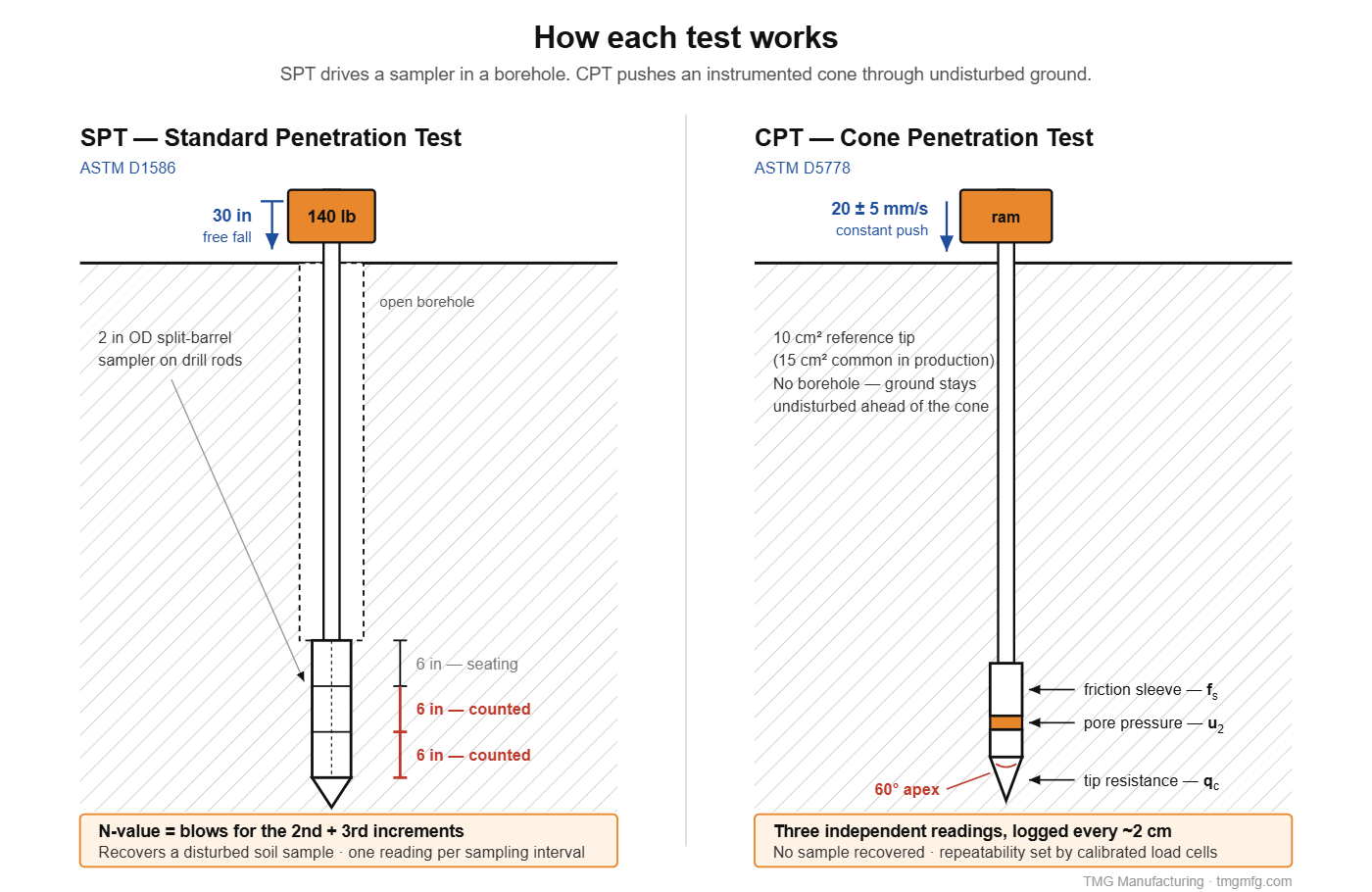
The SPT is a dynamic test. A 140-pound hammer falls 30 inches onto a drill rod, driving a 2-inch outside-diameter split-barrel sampler into the soil at the bottom of a borehole. You count the blows for each of three 6-inch increments; the sum of the second and third is the N-value. The procedure is governed by ASTM D1586/D1586M-18e1. Then you open the sampler and you have real soil — enough to classify it, run Atterberg limits, check moisture content, or send it out for corrosivity testing.
The CPT is a quasi-static test. A cone with a 60-degree apex — 10 cm² projected tip area is the reference size, 15 cm² is common in production work — is pushed into the ground at 20 ± 5 millimeters per second behind a matched friction sleeve (150 cm² on a 10 cm² cone). Load cells record tip resistance (qc), sleeve friction (fs), and, on a piezocone, pore water pressure (u2). ASTM D5778-20 requires readings at depth intervals no greater than 50 mm; most systems log every 2 centimeters. Nothing comes back up.
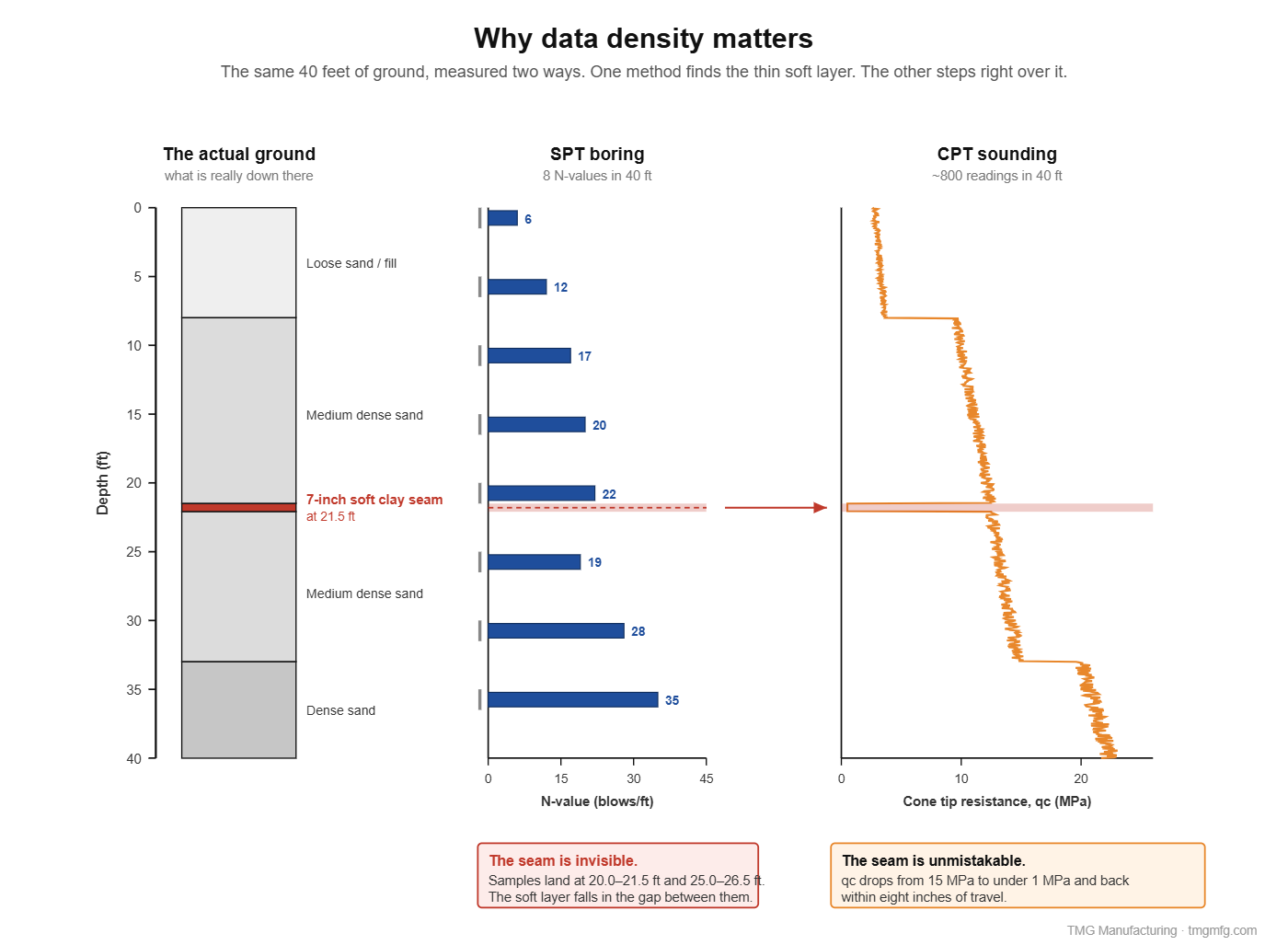
The difference in data density is what most people underestimate. A boring with SPT sampling at 5-foot intervals gives you roughly 20 N-values in 100 feet. A CPT sounding over the same 100 feet gives you well over a thousand readings across three independent measurements. Thin layers — a 6-inch clay seam, a loose lens in otherwise dense sand — are effectively invisible to a 5-foot sampling interval and unmistakable on a CPT trace.
Side-by-side comparison
| CPT | SPT | |
|---|---|---|
| Governing standard | ASTM D5778-20 | ASTM D1586/D1586M-18e1 |
| Data interval | Continuous (≤50 mm required; ~2 cm typical) | Discrete, typically 5 ft |
| Soil sample recovered | No | Yes — disturbed split-spoon sample |
| Production rate | ~400–600 ft/day | ~160 ft/day (hollow-stem auger, 5-ft sampling) |
| Operator dependence | Low — mechanized push, calibrated load cells | High — hammer type, rod length, borehole condition all affect N |
| Repeatability | Excellent | Moderate; requires correction factors |
| Works in gravel, cobbles, fill, rock | No — refusal | Yes, within limits; coring for rock |
| Detects thin layers | Yes | Usually not |
| Direct pore pressure measurement | Yes (piezocone) | No |
| Reaction required | 15–25 tons of rig or ballast weight | Rig weight, often supplemented with screw anchors |
| Lab testing on recovered soil | Not possible from the sounding | Yes |
Production rate figures follow Peter Robertson’s published comparison. His cost example — written in 2006 for the California market — put 400 feet of CPT at roughly $3,500 including plots and interpretation, against about $8,000 for three days of auger drilling plus lab cost on some 80 samples. Both figures are roughly 1.6 times higher in today’s dollars, and your local market will differ, but the ratio has held up: CPT is usually cheaper per foot of information and more expensive per day of rig time.
The N-value problem nobody mentions until the design is done
An N-value is not a soil property. It’s a measurement of how hard it was to drive a sampler with a particular hammer, through a particular rod string, in a particular borehole, on a particular day.
The energy actually delivered to the rods varies enormously with hammer type. Measured fleet averages put automatic hammers around 75 to 90 percent of theoretical energy, clustering near 80 — the Vermont and North Carolina DOT studies both land there. A safety hammer runs roughly 55 to 70 percent. An old donut hammer can fall below 50 percent.
Here’s the part clients get backwards: a low-energy hammer reports a higher N-value in identical soil, because it takes more blows to drive the sampler the same distance. Automatic versus safety hammers typically differ by about 40 percent. Automatic versus an old donut hammer can approach a factor of two — for the same ground.
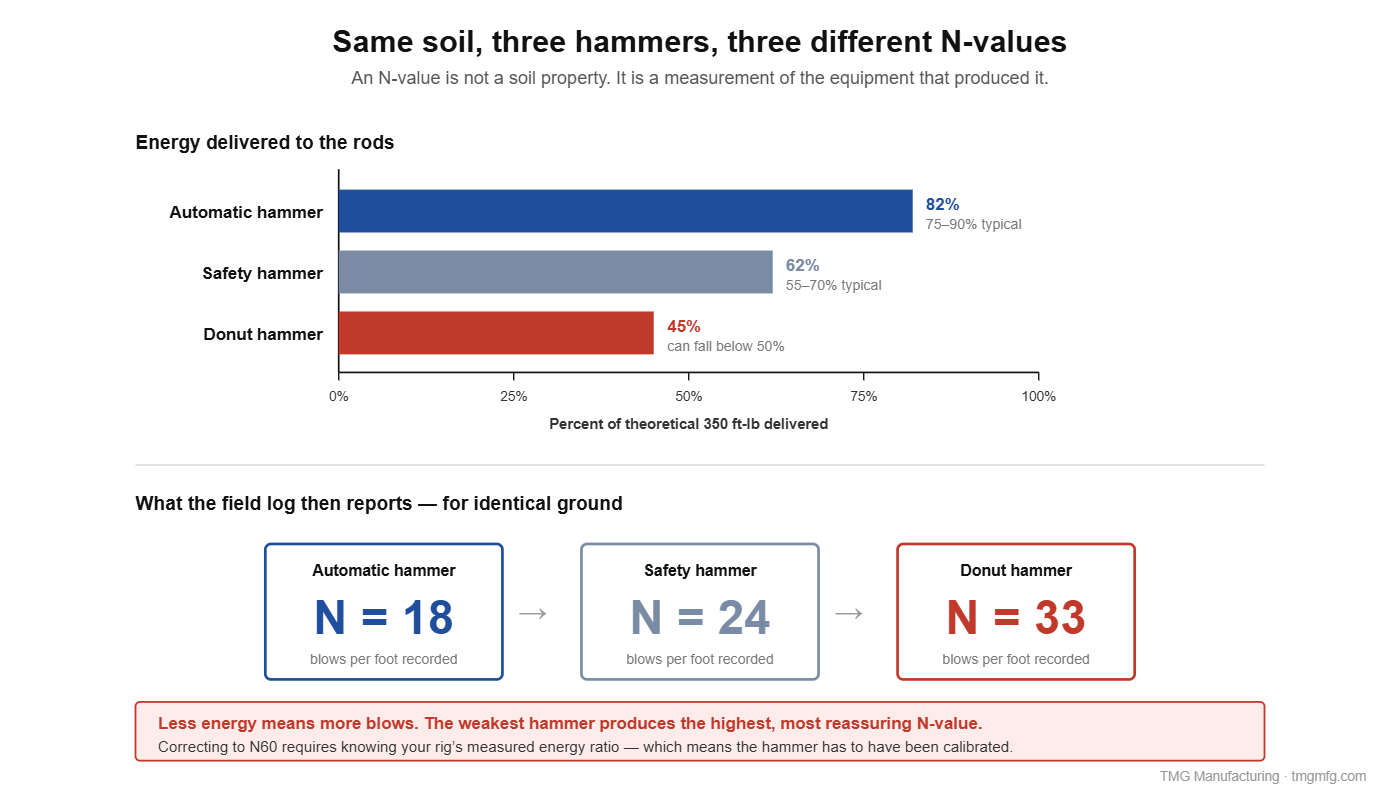
That’s why the profession applies correction factors for hammer energy, rod length, borehole diameter, and sampler configuration to arrive at N60, then normalizes for overburden to get (N1)60. It works, but it depends on knowing your rig’s actual energy ratio, which means the hammer has to have been calibrated. A lot of them haven’t been.
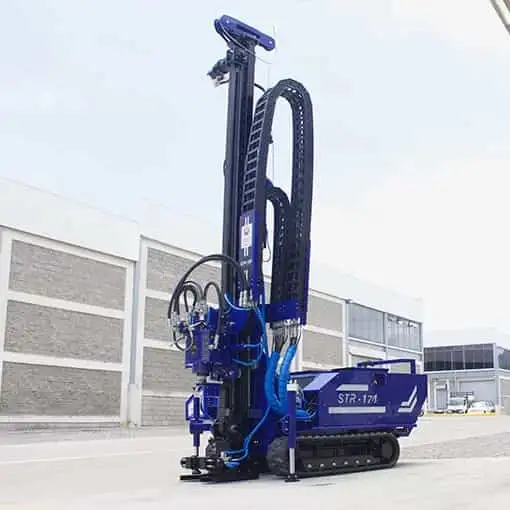
CPT sidesteps this entirely. The cone is pushed at a controlled rate by a hydraulic ram, and the load cells are calibrated instruments. Two crews with two rigs on the same site should produce nearly the same log. That repeatability is CPT’s strongest argument, and it’s an argument about the equipment — which is why we take hammer calibration seriously on the rigs we build.
Where CPT simply cannot go
This is the part CPT vendors tend to leave out.
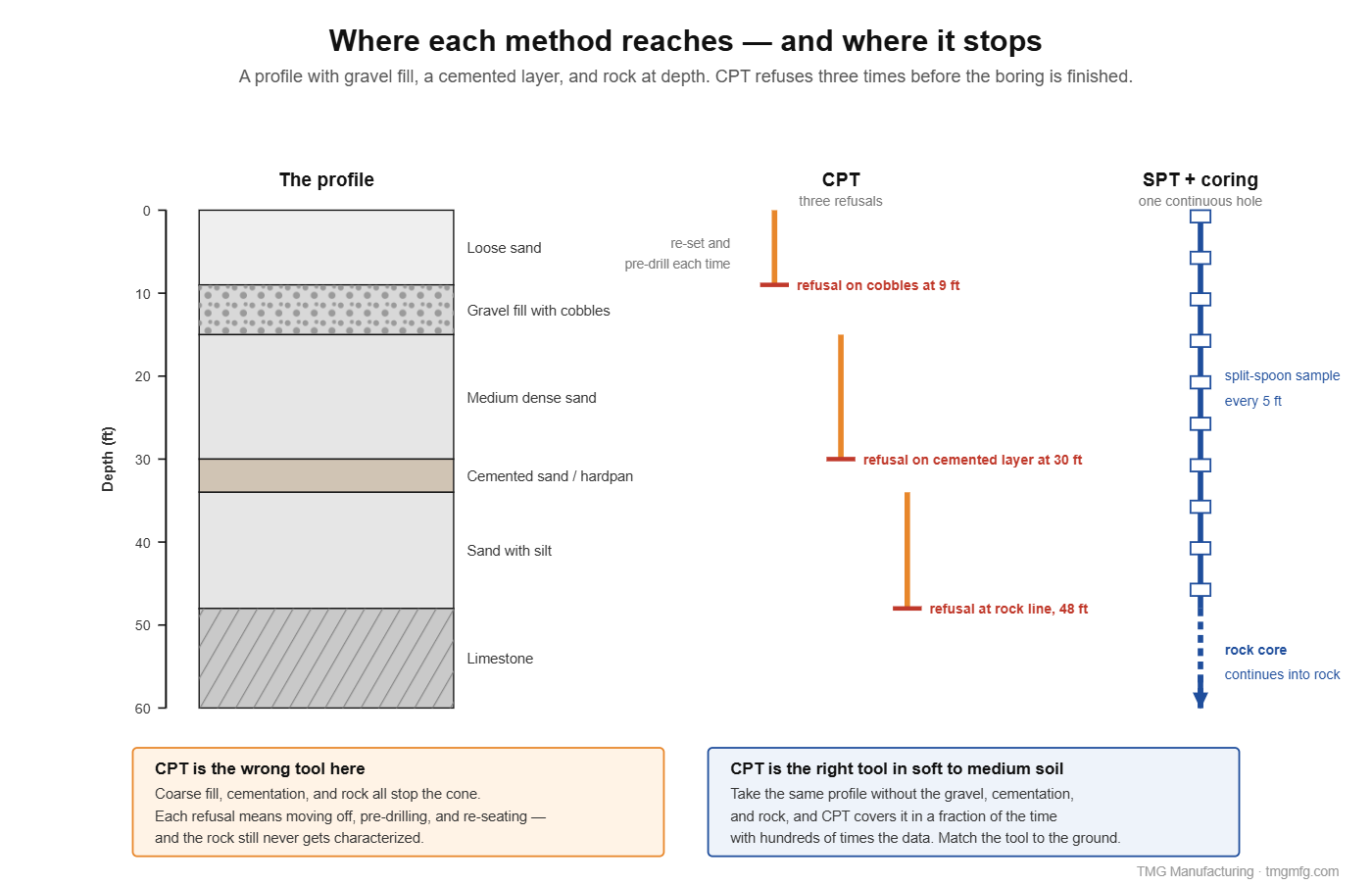
Gravel, cobbles, and construction debris fill. A cone 3.6 to 4.4 centimeters across meeting a cobble either deflects or refuses. You get a spike in tip resistance and a sounding that stops well short of target depth.
Cemented sands and hardpan. Common in parts of Florida, and a frequent cause of premature refusal.
Rock. CPT cannot characterize rock at all. If the structure bears on rock, you need core. Rock coring was long governed by ASTM D2113, which ASTM withdrew in 2023 without a replacement; it is still named in some codes and remains the de facto reference in practice. Depth rules vary by jurisdiction — the model IBC (§1803.5.6) requires borings at least 10 feet below foundation level where rock structure varies, while New York City is more prescriptive, calling for a double-tube core barrel of at least 2⅞ inches outside diameter cored no less than 10 feet below the lowest level of bearing.
Sites without reaction. A CPT rig has to push against its own weight. Most production units run 15 to 25 tons. On a site with poor access, soft ground, or overhead restrictions, that mass may simply not be deliverable — and a lighter rig will lift off the ground before it reaches depth.
Anywhere you need the soil itself. Classification, plasticity, organic content, contamination screening, corrosivity for buried steel — all of it requires a sample. This matters directly if you’re designing helical piles or any other steel deep foundation, where soil resistivity, pH, and chloride content drive the corrosion allowance and the galvanizing specification.
What the building code actually says
Worth knowing, and worth getting right: the model International Building Code does not address CPT at all. The words “cone” and “sounding” do not appear in Chapter 18. The IBC leaves the scope of investigation to the geotechnical engineer of record and the building official.
Some jurisdictions are far more specific. New York City Building Code §1803.5.2, “Alternative Investigative Methods,” states that CPTs may replace borings on a one-to-one basis, but in no case shall there be fewer than half the required standard borings, and no less than two standard borings — and it further requires that boring depth requirements be met with borings, not soundings.
That’s a useful model even where it isn’t law. The one code that bothered to write a rule did not treat CPT as a full substitute; it treated it as a method that can carry half the load. If your plan calls for eight borings, you can run four borings and four soundings — not eight soundings.
Florida follows the model IBC here, with no CPT provision. So in most of the country this is an engineering-judgment call, not a compliance checkbox. Check your AHJ before assuming either way.
CPT vs SPT: how to actually choose
Lean CPT when: the site is soft to medium soil with no gravel; you need to find thin compressible layers; settlement prediction governs; you have a lot of ground to cover on a schedule; or you need pore pressure data. CPT-based liquefaction triggering procedures are well established, and the continuous profile resolves thin liquefiable layers that 5-foot sampling misses — though SPT-based procedures are equally current, and the two are often run together as a cross-check.
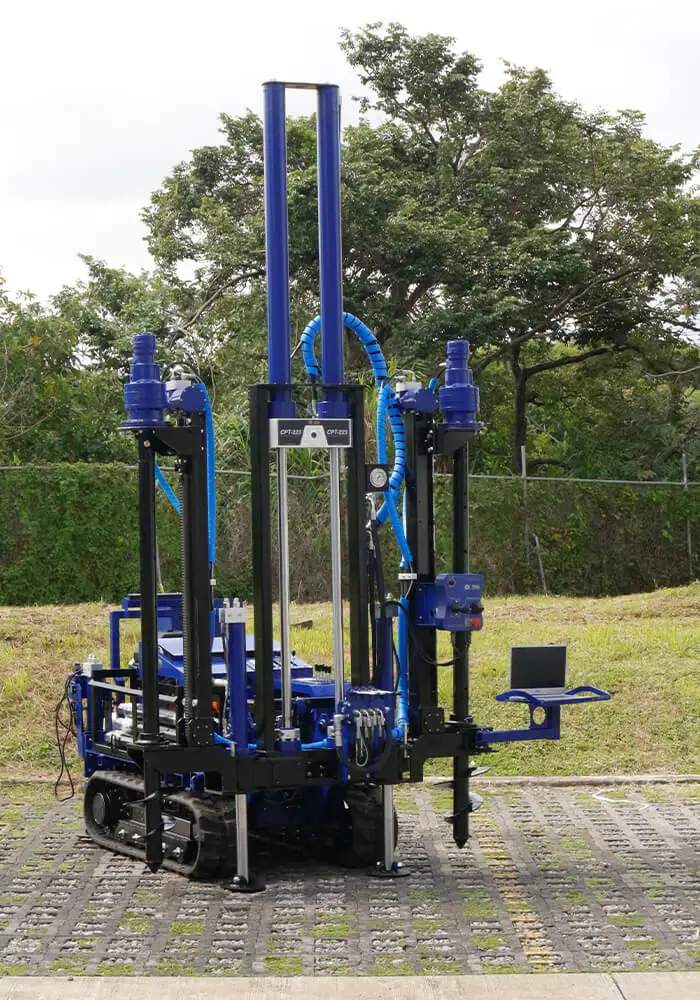
Lean SPT when: the profile includes gravel, cobbles, fill, or rock; you need samples for lab classification or corrosivity; the design is driven by an N-value correlation your reviewer expects to see; access is tight and you can’t get reaction weight on site; or local practice and the AHJ expect borings.
Use both when the project is large enough to matter — which is most of them. The efficient pattern is to run CPT soundings to map the site quickly and continuously, then place a smaller number of borings at the critical locations the CPT identifies, sampling where the profile actually changes rather than every 5 feet by default. You get continuous coverage and the samples the lab needs, usually for less than either approach alone done to the same confidence.
Why this shows up in your foundation design
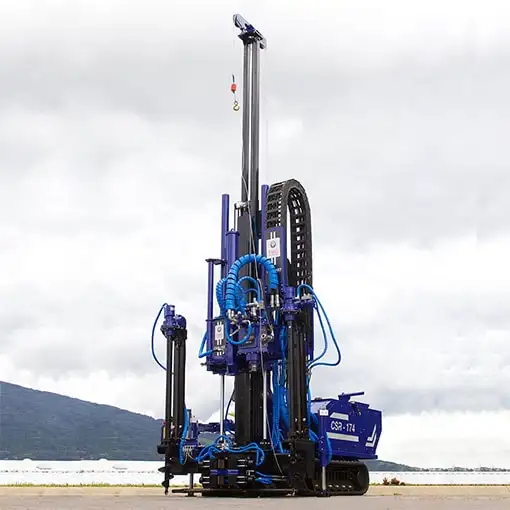
The CPT vs SPT decision eventually lands on a pile schedule. If you’re sizing helical piles, the CPT trace tells you where the competent bearing stratum starts and how consistent it is across the site — which determines helix depth and whether one configuration works everywhere or you need two. The SPT samples tell you what that stratum is made of, and whether the groundwater chemistry is going to eat galvanizing in twenty years.
Neither test alone gets you there. That’s the whole point. Once you have the profile, our Helical Pier Load Calculator is a quick way to sanity-check a configuration before it goes on a drawing.
Questions about which rig configuration fits your work? TMG builds SPT and coring rigs, CPT and DMT test rigs, and the cone equipment that goes with them — and we repair hydraulic drill rigs regardless of who made them. Call (813) 464-2299, toll-free 1-888-508-RIGS, or email info@tmgmfg.com.
Ramzy Moumneh is the founder of TMG Manufacturing in Tampa, Florida, which builds geotechnical drill rigs and deep foundation products.
Frequently asked questions
Is CPT more accurate than SPT?
CPT is more repeatable and far more continuous, so it produces a more reliable picture of how soil properties change with depth. SPT is more versatile — it works in ground where CPT refuses, and it recovers a sample. “Accurate” depends on which question you’re asking.
Can CPT replace SPT entirely?
Rarely in practice, and in some jurisdictions not legally. The model IBC is silent on CPT and leaves the call to the engineer of record and the building official. New York City is explicit: CPTs may replace borings one-for-one, but at least half the required standard borings — and never fewer than two — must remain, and boring depth requirements must be met with borings.
How deep can a CPT go?
Depth is limited by reaction weight and soil resistance rather than by the equipment itself. A 20-ton rig commonly reaches 150 feet or more in soft to medium soils, and refuses much shallower in dense sand or gravel.
Why do two crews get different N-values in the same soil?
Mostly hammer energy. A low-energy hammer has to hit more times to drive the sampler the same distance, so it reports a higher N in identical soil. Automatic versus safety hammers typically differ by about 40 percent; automatic versus an old donut hammer can approach a factor of two. That’s what the N60 correction exists to fix.
Do I need a sample if I have CPT data?
Yes, if you need soil classification, Atterberg limits, organic or contaminant screening, or corrosivity testing for buried steel. CPT infers soil behavior type; it does not recover soil.
Leave a Reply